
Dock and retaining walls survey
A GPR survey shows how a dock or retaining wall is built and where voids or washout have formed behind or within it, without breaking into the wall.
What the survey finds
When you need a wall survey
Dock, quay and retaining walls often go years without inspection. Over time, water and tides wash material out through joints and cracks. Voids form behind or within the wall, and the problem may only show when the surface above settles or the wall starts to move. A failing wall puts the land, buildings and people next to it at risk.
A survey is typically needed:
- as part of a routine inspection programme
- when the ground behind a wall has settled or cracked
- before loading the land behind a wall with plant, stock or new buildings
- to plan repairs and grouting
- where the wall's construction is unknown
What the survey finds
GPR shows the thickness of the wall and how it changes along its length and with depth. It shows construction details such as facing and core, ties and reinforcement in concrete walls. Most importantly, it shows voids within the wall and in the fill behind it. These areas are mapped so repairs can be targeted where they are needed.
How it is done
We scan the face of the wall or the ground behind it, or both, depending on access and what you need to know. Antenna frequency is chosen to balance detail against depth. The results are processed in the office and issued as a CAD drawing with a report that sets out the findings and recommended next steps.
Scanning the wall face
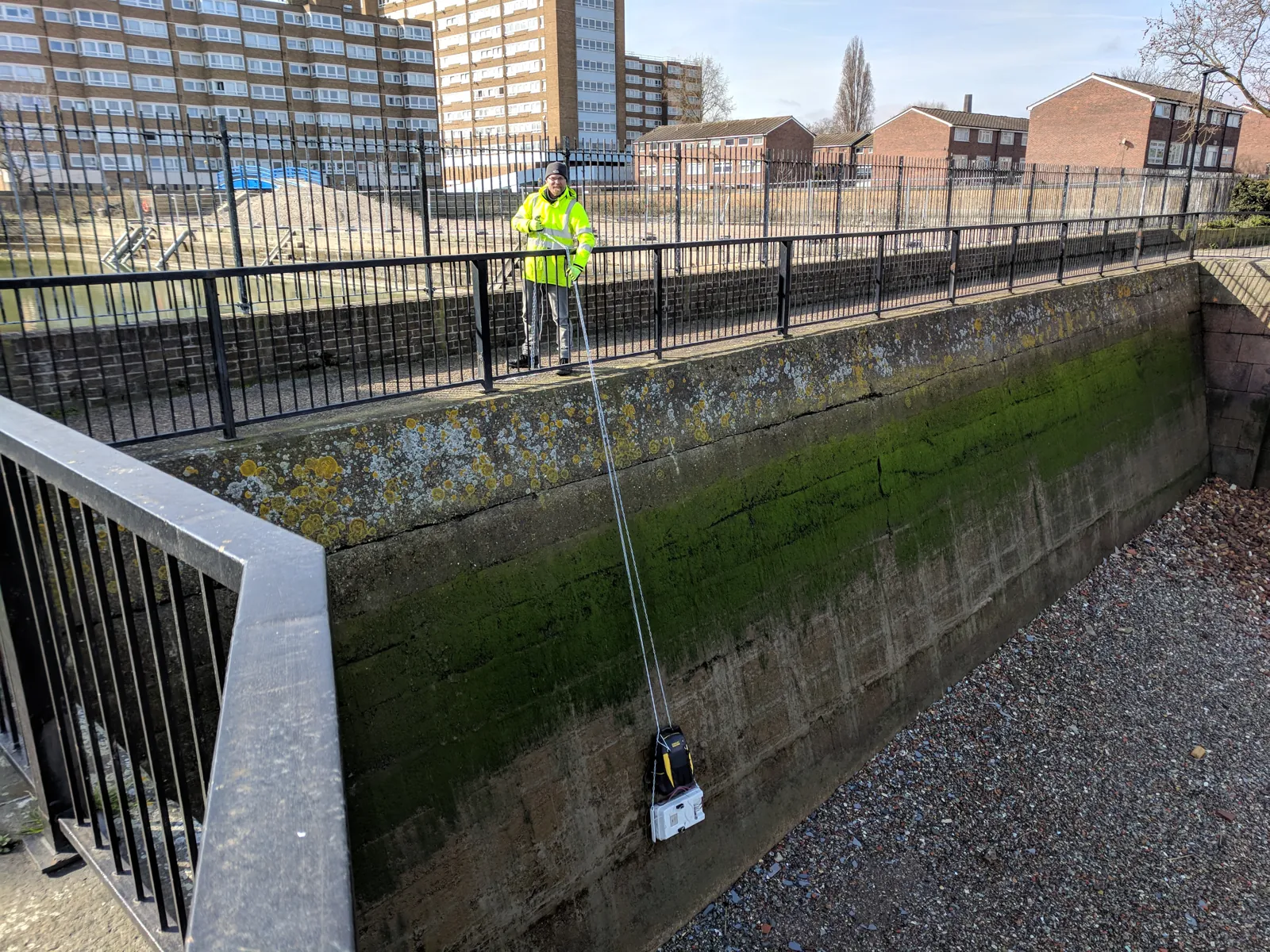
Where the face of a dock or retaining wall can't be reached on foot, we lower the antenna down the face on ropes or chains and scan in vertical lines, alongside lines on the path or quay above. On a historic dock wall in London this showed no significant voids, which allowed the owner to go ahead with a planned development.
Limits you should know about
Salt water and wet, saline fill absorb the radar signal and reduce the depth we can see. Thick masonry walls may not be seen through to the back face. Access to a dock face may need a boat, a cherry picker or work at low tide. We will discuss access and expected results with you before quoting.
Why use GPR
- It causes no further damage to a wall that may already be weak.
- It covers the whole wall rather than a few cores.
- Early detection lets you repair before a collapse.
- Results are presented as clear drawings for engineers.
We have surveyed dock and retaining walls for local councils and asset owners.
Questions we're asked
Can GPR see behind a retaining wall?
Often, yes. Depending on the wall's thickness and material, GPR can see through the wall into the fill behind it. Where it cannot, we can scan the ground behind the wall from above.
Do you need to break into the wall?
No. The survey is non-destructive. We may recommend a small number of cores afterwards to confirm key findings.