
Locating buried obstructions
Old foundations, tanks and buried slabs can stop a piling rig or excavator for days. A GPR survey finds them at the planning stage, while there is still time to design around them.
What the survey finds
When you need an obstruction survey
Most construction projects carry a contingency budget for things nobody expected. An obstruction found by the piling rig or excavator can use it up quickly through standing time, redesign and programme delay. An obstruction survey belongs in the early planning stage. It is commonly used:
- before piling, especially on brownfield sites
- before excavating for basements, drainage or foundations
- on sites with a history of earlier buildings or industry
- where old tanks, cellars or chambers are suspected
- before installing ground anchors or soakaways
What the survey finds
GPR detects old foundations, buried slabs, tanks, cellars and chambers, as well as pipes, cables and drains. It can also show shallow rock, rubble-filled areas and loose fill. The survey maps their position, extent and approximate depth.
Where buried services are the main concern, a utility survey using electromagnetic location and GPR together gives a fuller picture.
How it is done
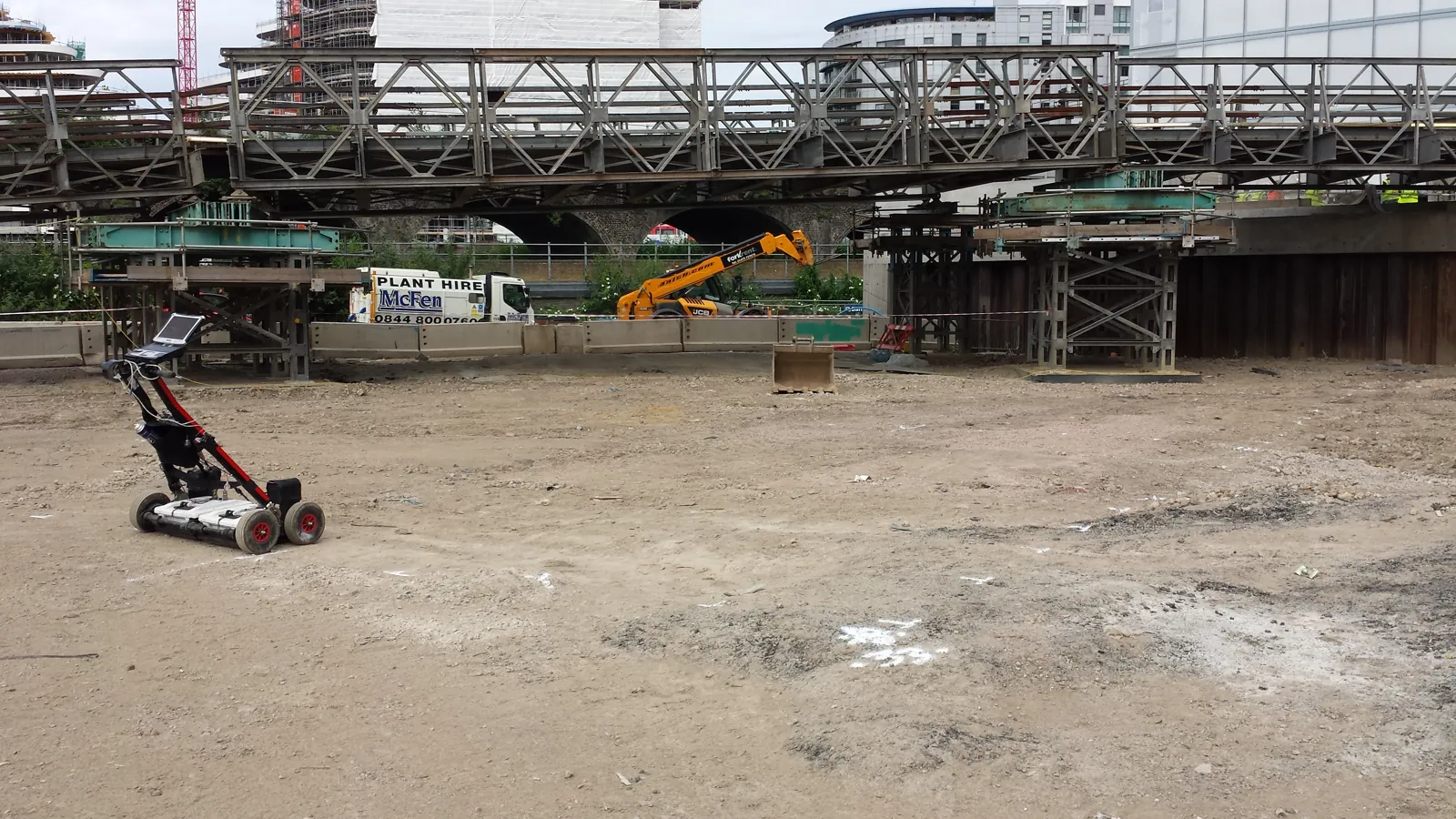
We scan the site in a grid, choosing the antenna to suit the depth of interest. Obstructions can be marked on the ground as we go. The data is then processed in the office and issued as a CAD drawing with a report. Where you need the findings tied to your site grid, we reference the survey to your survey control.
Limits you should know about
GPR depth is limited in wet clay and saline ground. Deep obstructions, or small objects at depth, may not show. Large areas of rubble can mask what lies beneath. GPR shows that something is there, but it cannot always tell you what it is. We recommend trial holes to confirm significant findings before work starts.
Why use GPR
- It finds problems before the rig arrives.
- The cost is small compared to a delayed programme.
- It reduces the risk of damage to plant and buried services.
- It improves safety on site.
We carry out obstruction surveys for construction companies and local councils.
Questions we're asked
How deep can GPR find obstructions?
It depends on the ground. In dry sand and gravel GPR can see several metres down. In wet clay it may only reach a metre or so. We will tell you what to expect for your site when we quote.
Can you find old pile caps?
Not reliably. A concrete pile cap gives a weak contrast with the ground around it, so we don't quote for pile cap location on its own. As part of a wider survey we can look for them on a best-endeavours basis. Our guide to pile caps explains why.