
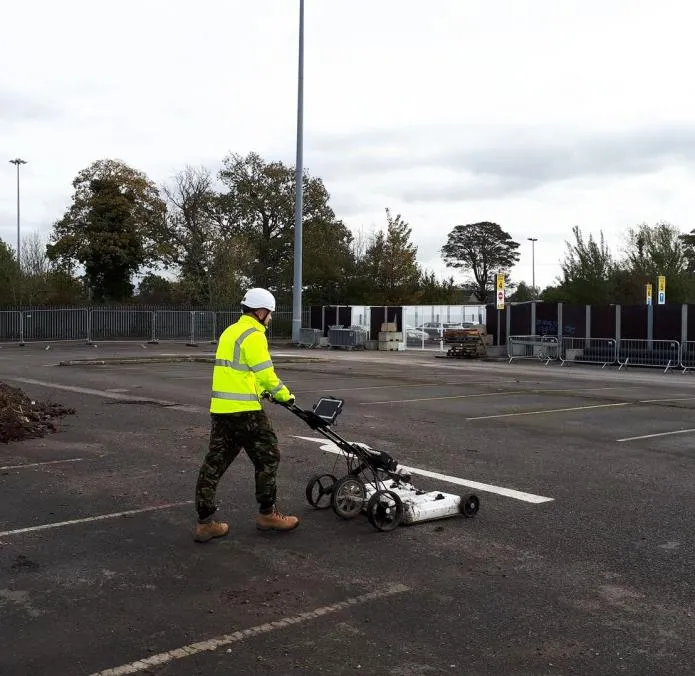
There is no single price for a ground penetrating radar (GPR) survey. Every site is different, and the cost depends on what you need to find, how much ground there is to cover and what you need to receive at the end. This guide explains what drives the price and how to compare quotes.
Why a GPR survey is usually money well spent
GPR is non-destructive. It maps what lies below a floor, road or field without digging, coring or boreholes. Breaking ground to find out what is there costs far more in time and money, and it can still miss things.
Most of our clients commission a survey before groundworks, drilling or cutting. Knowing where pipes, cables, voids and old foundations are before you start reduces the risk of a service strike, expensive repairs, delays and injuries on site.
What affects the price
Size of the survey area
The area to be scanned is the biggest single factor. A few coring positions in a slab can often be cleared in a few hours. A full warehouse floor, a road corridor or a development plot takes longer. A clear red-line boundary or marked-up plan lets us estimate site time accurately.
Access and site conditions
Open, clear ground is quicker to survey than a congested yard, a live car park or a building full of racking. Things that slow the work down include:
- parked vehicles, stored materials or furniture over the survey area
- traffic management, permits or escorted access
- manholes and chambers that need lifting
- rough or uneven ground
Site time: priced by the day
Site time is priced in days. The survey team works on one job per day, so a single visit is a day's booking even when the scanning itself is quick. Small jobs, such as clearing a few coring positions or checking one trench line, are charged at our minimum rate, which is a reduced day rate.
Larger areas run to two or more days. Where we expect a job to finish early on its last day, we take that into account in the price. Putting several small areas on the same site into one visit costs much less than booking separate visits.
Travel
Most of our work is in the south of England: Hampshire, Dorset, Wiltshire, Sussex, Surrey and London. We are based in Southampton and travel across England and Wales for larger jobs. Distance and any overnight stays are reflected in the quote.
Out-of-hours working
Some sites can only be surveyed at night, at weekends or outside trading hours, for example busy roads, shops, hospitals and live warehouses. We can work out of hours, and this is priced to reflect the time of day.
Processing, interpretation and reporting
Raw GPR data is not a finished result. An experienced surveyor has to process it in specialist software and interpret the reflections. GPR shows that something is there and how deep it is. It cannot say on its own what the object is. Turning the data into a clear drawing and report is a significant part of the work, and the more detail you need, the more office time is involved.
Deliverable format
What you need at the end affects the price:
- Marking out on site only: findings sprayed or chalked on the ground or slab for your contractor.
- CAD drawing and report: findings drawn in PDF and DWG, with a report on method, findings and limitations. These are normally issued within 15 working days of the site work.
- Both: marking on site plus a drawing for your records or design team.
PAS 128 quality level
For utility surveys, the PAS 128 quality level you need makes a difference. Most surveys are carried out to QL-B, using electromagnetic location (EML) and GPR, supported by records and site reconnaissance. Utility surveys need statutory records (STATS). You can provide these, or we can obtain them at extra cost.
Ground conditions and depth
How deep the targets are matters. Standard GPR utility mapping typically reaches around 2 to 3 metres. In dry sand or rock, GPR can see much deeper. In wet clay and other conductive ground, penetration can drop to a metre or less. GPR also performs poorly in salt water. Where depth is critical, we will tell you at the quoting stage what is realistic.
What you are paying for
A survey price covers more than the equipment. It covers the surveyor's experience in planning the grid, choosing the right antenna, collecting good data and interpreting it correctly. Our senior GPR surveyors have over 20 years' experience, and our team has backgrounds in geophysics, geology and archaeology.
GPR gives precise results, but no survey method is 100% accurate. Results depend on ground conditions, the materials involved, the depth of the targets and the skill of the surveyor. Findings near critical services should be verified before digging.
Comparing quotes
The cheapest quote is not always the best value. Before you choose a provider, check what each quote includes:
- Is site marking, a CAD drawing, a report, or all three included?
- Which areas and depths are covered?
- Are STATS records, travel and out-of-hours working included?
- Which PAS 128 quality level will be delivered, if any?
- When will you receive the results?
A low price that leaves out the drawing or report can cost more once you add the missing items. We aim to be transparent about our costs and can provide a detailed breakdown with your quote.
Questions to ask a GPR provider
Price is only part of the decision. A good surveyor will think about your survey before arriving on site. Ask:
- Do you regularly carry out this type of survey? Utilities, concrete, voids and graves each need different experience.
- Will the target show up? GPR detects a target when it differs from the material around it. A good provider will tell you if there is not enough contrast, rather than take the job anyway.
- Which antenna and grid spacing will you use? Lower frequencies reach deeper but miss small targets. Smaller targets need closer scan lines.
- Will you test in more than one place? Ground and concrete can change across a site.
- What will I receive, and when? Ask for the format of the drawing and report and the delivery time.
How to get a quote
To price your survey accurately, send us:
- the site address or postcode
- the type of survey you need and what you want to find
- a plan or red-line boundary showing the survey area
- any access restrictions or preferred working hours
- the deliverables you need: marking, drawing, report or all three
Our quotations are valid for 90 days. We work for contractors, engineers and homeowners.
Request a quote, or call 020 3931 5759 to talk through your project. You can also read more about our GPR survey services.